
Teenage Sex and Death at Camp Miasma review
Jane Schoenbrun’s most accessible film shows a love of slashers rarely so publicly stated.
New movie reviews will not contain spoilers.
Teenage Sex and Death at Camp Miasma
Directed by Jane Schoenbrun
Written by Jane Schoenbrun
Starring Hannah Einbinder and Gillian Anderson
Teenage Sex and Death at Camp Miasma Review
Early in writer/director Jane Schoenbrun’s third feature film Teenage Sex and Death at Camp Miasma, the two leads briefly discuss the movie Sunset Boulevard. They’ve forgotten the name of its reclusive main character while trying to use it as a comparison to this film’s reclusive former “star” Billy (Gillian Anderson). It’s a brilliant moment. And a meaningful one. Billy, you see, starred in the in-universe golden age of slashers hit Camp Miasma. She now resides at the shooting location of the film…and is every bit as mysterious as Sunset Boulevard’s leading lady. Whose name was Norma Desmond, by the way.
Jane Schoenbrun knows that the character’s name is Norma Desmond. Sunset Boulevard was one of David Lynch’s favorite films. Schoenbrun is a Lynch disciple. One of the rare filmmakers able to produce truly “Lynchian” works without feeling dishonest or a poor copy. But the characters don’t remember Norma Desmond’s name for a reason. Billy is the former star of a slasher movie. Kris (Hannah Einbinder) is the independent filmmaker tasked with rebooting the series. Kris can rattle of the stars of slasher movies like they’re family members…but the main character of one of the most revered films of all time? It eludes her. Despite the generational gap between Kris and Billy…it eludes Billy too. This was the moment where Teenage Sex and Death at Camp Miasma started speaking directly to me. Even though I knew Norma Desmond’s name
Schoenbrun hit the scene in a relatively big way with We’re All Going to the World’s Fair right around the time this website launched. Their follow up feature I Saw the TV Glow garnered acclaim and did a bit of unexpected box office business to boot. I thought World’s Fair was a good movie. It wasn’t my cup of tea, but I could recognize the signs of a talented filmmaker. I thought I Saw the TV Glow was great. But…I also wished I could have connected to it more. That’s not a failure of the movie…or even of mine. It was simply delving into experiences I hadn’t had and emotions I hadn’t felt. I could appreciate it…I could enjoy it…but I couldn’t see myself in it.
I saw myself in Teenage Sex and Death at Camp Miasma. What’s interesting about it is that I didn’t see myself in the main plot of the story. Or, should I say, main metaphor. What Teenage Sex and Death at Camp Miasma is about isn’t remotely hidden. It’s actually right there in the title. The concept of linking sex and death in slasher movies is hardly a new one. People have been reading that into the subgenre for as long as there has been one. Perhaps not as overtly as Schoenbrun does here…naming the Camp Miasma series’ killer The Little Death should be a bit too on the nose but somehow never feels that way.
There is also some pointed commentary on the film industry here…which is pretty enjoyable. From why a queer ultra-indie director was tapped to reboot a problematic old IP to a hilarious zoom meeting about the project, Teenage Sex and Death at Camp Miasma has some bones to pick with the way things are done. But it’s the place that the movie comes from that really makes it work. Sure, its killer is right out of the Sleepaway Camp playbook (with an interesting twist that, frankly, I’d have loved to see someone use in a reboot of that franchise). Sure, it has a meta-concept that adds a wild layer to the proceedings. And sure, it’s about sexual self-discovery and comfortability. But it’s also about how fucking great slasher movies are.
That last part…that’s me. That’s what I walk around thinking and saying in my day to day life. This dismissible garbage genre full of problematic works is something that I love. It’s something Schoenbrun clearly loves too because the entirety of the story’s angle is from that perspective. Billy and Kris don’t forget Norma Desmond’s name because it’s a difficult pull or because they haven’t seen it since they were young. They forget it because it’s beneath them. All the awards and decades of adoration…that’s for other people. Let’s talk about Camp Miasma and its dozen sequels with the reverence they deserve.
That’s what makes Teenage Sex and Death at Camp Miasma feel so special. Whether Friday the 13th: A New Beginning marked your sexual awakening, or you find the camera movement in Friday the 13th Part 2 to be among the most interesting ever committed to film…this movie sees you. And it agrees with you. And that makes it one of the most honest and impactful love letters to slasher cinema ever made.
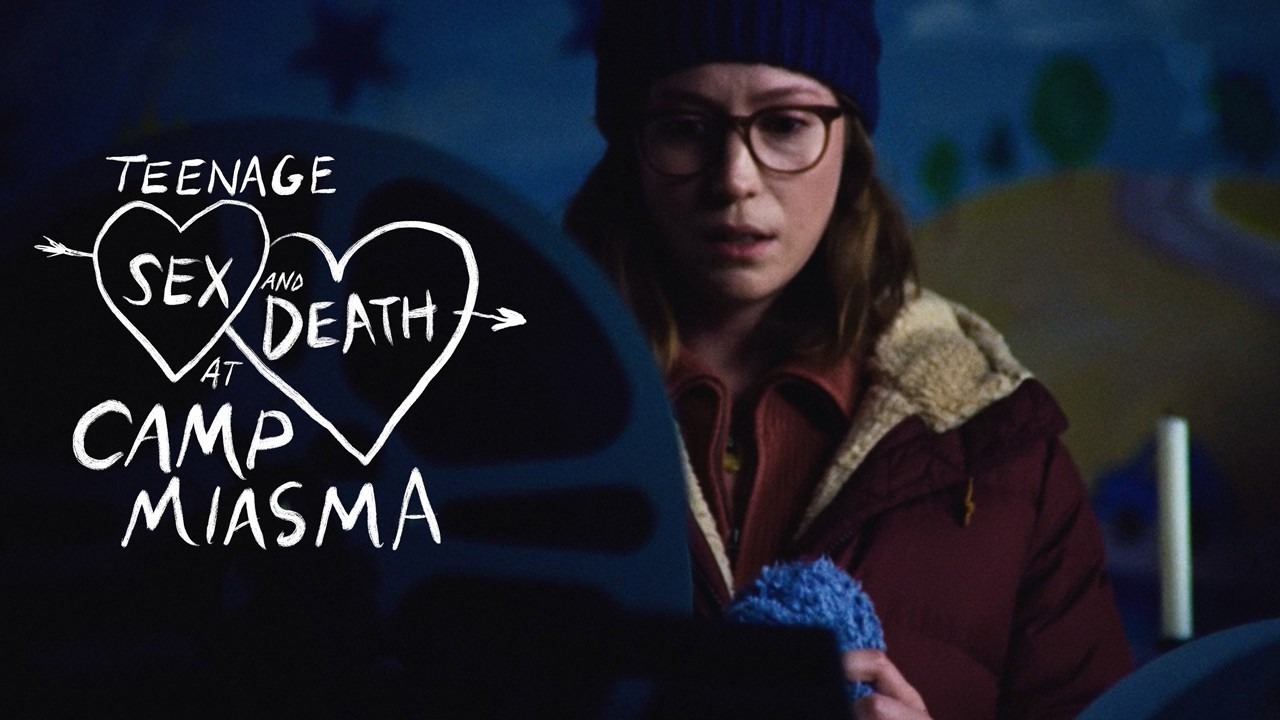
Anderson and Einbinder are fantastic, of course. I assume you gleamed that much from the reviews that have come out before this one. Anderson lends a mythical quality to an actress forgotten by the industry the same way she’s forgotten it right back. Einbinder is perfect for the role of the slasher loving misfit who has big plans to turn the genre on its head…but also loves it so much that she’s spent her life searching for its true meaning. Einbinder’s Kris has a pacing to her that stands out from all of the characters found in Schoenbrun’s other work…including Anderson here. There’s a universal ability to relate to Kris that has been purposely absent in World’s Fair and I Saw the TV Glow. Kris is our window into a world we love…and you can’t help but look.
Speaking of looking…you might be surprised how much of Teenage Sex and Death at Camp Miasma is spent watching the original Camp Miasma movie. The film within a film is on display for pretty much the entire second act of the movie. It features a completely over the top kill sequence…and almost the entire lead up to that happening complete with character introductions, a doomsayer (played by noted Lynch actor Patrick Fischler) and a campfire lore drop. Kris sits next to Billy watching the old film print with love, awe and reverence. Exactly the way the golden age of slashers should be watched.
Scare Value
The metaphor in Teenage Sex and Death at Camp Miasma isn’t difficult to spot. But it’s the larger picture that really makes it work. We’ve rarely, if ever, seen such a pronounced profession of love for a maligned subgenre like the slasher movie. Certainly, never as artistically. Yes, it’s about sexual awakening. Yes, it’s a commentary on the industry. But it’s the reverence for something often reviled that makes an unexpected section of the audience feel seen.
4.5/5
Teenage Sex and Death at Camp Miasma Link
Buy tickets on Fandango