

Brute 1976 review
Travel back to 1976 for a story that chooses to be about more than its influences.
New movie reviews will not contain spoilers.
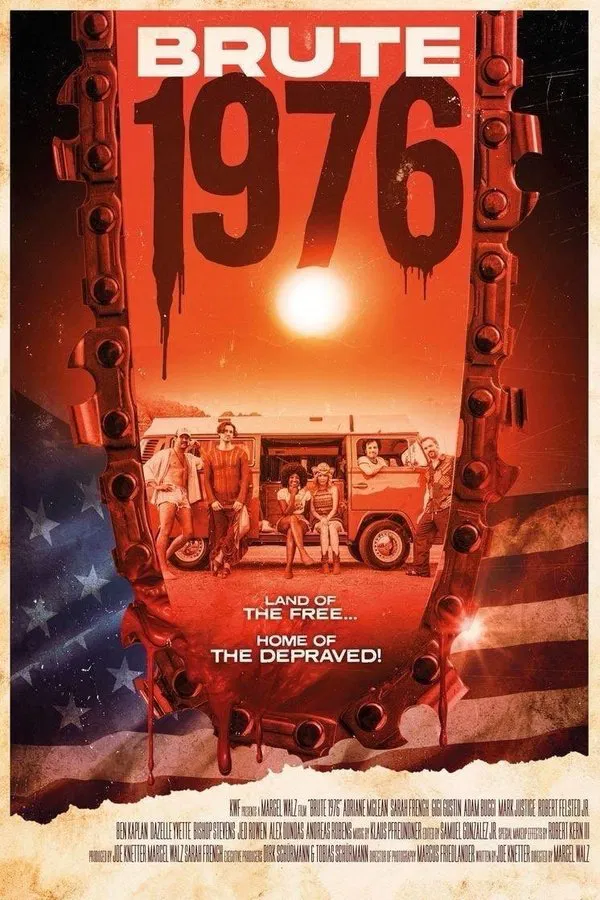
Brute 1976
Directed by Marcel Walz
Written by Joe Knetter
Starring Adrianne McLean, Sarah French, Gigi Gustin, Adam Bucci, Alex Dundas, Robert Felsted Jr. and Mark Justice
Brute 1976 Review
There’s a scene that comes around the start of Brute 1976’s second act that I thought was going to inform what the tone of the film was going to be. Our main group of characters/victims wander around a lot full of abandoned vehicles. The old school horror fan in me recognized the meaning of those vehicles. We see them in The Texas Chain Saw Massacre…one of the obvious influences on Brute 1976. They quietly tell a long term story that we don’t have to see to understand. This has happened before. More than once. The characters in Tobe Hooper’s masterpiece don’t notice the abandoned cars while looking for help with their own automobile troubles. The characters in Brute 1976 take the time to inspect the dozens of vehicles trying to warn them. They remain blissfully ignorant of the danger they’ve stumbled upon.
I found the whole scene to be funny. A kind of intentionally unintentional nod towards a clever tone. We aren’t watching a post-Scream horror movie. There will be no winks or nods or knowing glances. The Texas Chain Saw Massacre exists within this world. It’s even namechecked by the character most likely to believe/figure out what’s going on around him. But they haven’t learned anything from it yet. It’s a horror movie. Sure, it scared them…but it was based on something that happened in Wisconsin years ago. They weren’t written from the perspective of five decades of breaking down the meaning of everything that happened on screen. Set in 1976…it hadn’t yet influenced generations of horror films and characters that followed.
I think that Brute 1976 mostly adhered to this idea that I made up while watching that scene. But it isn’t the point of the story. In fact, I was making a mistake looking for that tone in the first place. When a movie like this comes along…so obviously inspired by Chain Saw and The Hills Have Eyes and even The Silence of the Lambs despite the latter two not existing in the time period its set in…you expect it to take a position. Would this be a parody or an homage? A commentary or a throwback? Brute 1976 may contain pieces of each of those ideas…and more than a few parts of those movies…but it ends up doing the most unexpected thing it can do with all of it. Brute 1976 sets out on its own path.
The story begins with two women having an unrelated bit of car trouble. They quickly run afoul of a masked killer with a chainsaw (among other weaponry). The film takes place in a (mostly) vacant desert town…we first meet a member of the “family” who resides there in a cave the women look for shelter in. The masked killer is clearly inspired by The Texas Chain Saw Massacre’s Leatherface. The concept of Brute 1976’s family initially recalls the same film. Later, we’ll be introduced to a character influenced by The Silence of the Lamb’s Buffalo Bill. The location brings to mind The Hills Have Eyes. The movie doesn’t hide its many inspirations. It uses them as a starting point.
The main group that we will follow through Brute 1976 arrives in the desert for a photo shoot. The movie takes some time introducing the characters and their relationships…a concept that is, in itself, a throwback to the era it takes place in. Eventually…the blood begins to flow in earnest. The truth is that Brute 1976 could have played things completely straight from there and delivered on expectations. It has a few new moves up its sleeve though. The homages and nods slowly begin to transform into something that feels more original. The story makes choices that a version made in 1976 wouldn’t have thought to make. Twists that work because the film has conditioned you to expect the expected.
I’m not talking about groundbreaking narrative shifts…but I’m talking about surprisingly effective ones. Brute 1976 presents you with a story that you feel can only go one way because of its chosen era…and then makes some slight zigs and zags. Unexpected character moments or larger plot points that catch you off guard because you think you’re watching a recreation of something familiar. But it is familiar, nonetheless. It feels like a progressive version of a period piece. Pushing ideas forward that wouldn’t exist for another ten years. Placing them in a purposeful historical artifact enhances both parts.
It also allows Brute 1976 to get away with some of its holes. Not everything feels period specific…not every performance rings true…not every kill works. They all work better in concert with the overall aesthetic and willingness to push beyond it, however. The story ends up being almost as much about 1976 America as it does the violent word chosen to precede it in the title. There’s some commentary about the time period that’s used to give the story’s possible final girl some extra definition. But, like the Fast and Furious movies before it…Brute 1976 is about family. The movie establishes characters that I suspect we will see again in the future. Given how interestingly this movie uses its 1976 setting from the politics of the time to the films of the era…I welcome revisiting them in Brute 1986. Possible Reagan-era ideology and a B-level slasher aesthetic? Bring that on.
Scare Value
Brute 1976 may add up to more than the sum of its parts. It makes plenty of questionable choices…but the total package is an interesting one. Though it rarely feels like it is fully committed to any particular idea…the larger concept works. It’s loose. It’s familiar and original sometimes in the same scene. Most importantly, Brute 1976 doesn’t allow itself to be confined by the box it has chosen to play in. Those little shifts make the finished story feel fresh…and give it ample room to continue into a new (old) era.
3.5/5
Brute 1976 Link
Rent/Buy on VOD from Amazon